
Wadjay automatic C Z U purlin roll forming machine: C/Z/U interchangeable via adjustable round wheel, 80-300mm, ±1mm at 30-50m/min. Delta PLC, 45# rollers, hydraulic cut, CE/ISO. Quote.
One Machine Instead of Three Purlin Lines
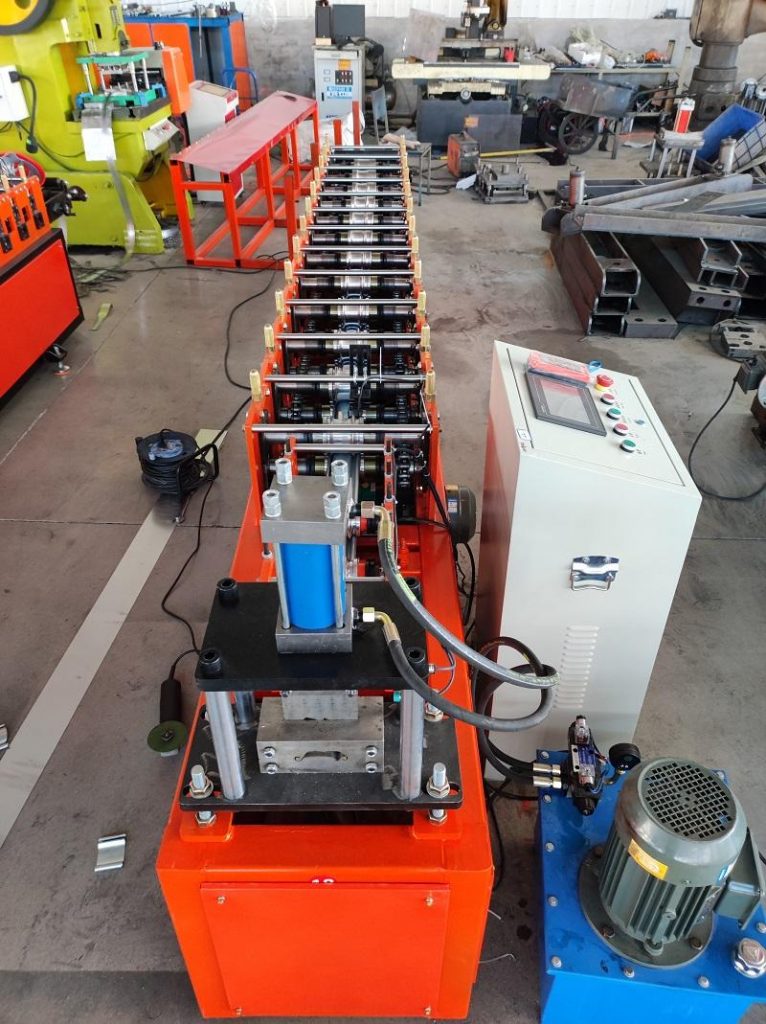
In steel-structure fabrication, the usual trap is buying a C purlin machine, then a Z purlin machine, then a U channel machine — and watching two of them sit idle between orders. The Wadjay automatic C Z U purlin roll forming machine is built around the opposite idea: one chassis, one roller system, three profiles.
In Wadjay’s Zhengzhou workshop, every CZU line is commissioned against the customer’s actual profile drawing before crating. The engineering team runs a 3D pass-sequence check first, then bends a first-article coil through the full flow — decoiler, leveling, roll forming, hydraulic cut — and measures web height, flange squareness and cut length on the finished purlin. The test run is filmed, the dimensional report is attached to the packing list, and only then does the line get cleared for container loading. That is not a “high precision” slogan; it is a verifiable commissioning record a buyer can check against the PO.
The machine covers a web width range of 80–300 mm, runs galvanized, cold-rolled and color-coated strip, and holds ±1 mm cutting tolerance at 30–50 m/min on light-gauge configurations (0.3–0.8 mm standard; heavier gauges quoted per drawing).

| Parameter | Wadjay CZU Purlin Machine |
|---|---|
| Profile type | C, Z, U channel(interchangeable) |
| Web width | 80 – 300 mm |
| Material | Galvanized / PPGI / cold-rolled steel |
| Thickness | 0.3 – 0.8 mm(light-gauge base)· 1.0–3.0 mm on heavy config |
| Line speed | 30 – 50 m/min(profile-dependent) |
| Cutting tolerance | ±1 mm |
| Forming stations | 10 stations(base)· up to 18–22 on heavy version |
| Roller material | High-grade 45# forged steel(Cr12 option) |
| Shaft | φ55 mm base(φ80/85 heavy)· 45# chrome-plated |
| Middle plate | 14 mm cast-steel drawing plate(anti-deflection) |
| Quick-change | Adjustable round-wheel design, no full roller swap |
| Control | Delta PLC + touch HMI |
| HMI languages | English / Chinese / Spanish / Russian |
| Modes | Automatic(length+quantity)· Manual(sample/maintenance) |
| Cutting | Hydraulic guillotine, Cr12 blade |
| Main power | 4 kW(base)· 7.5–15 kW on heavy config |
| Hydraulic power | 3 kW(base) |
| Decoiler | 3T manual(hydraulic 5–10T optional) |
| Voltage | 380V/50Hz/3-phase(customizable) |
| Certification | ISO(CE configurable per market) |
| Warranty | 12-month standard + spare parts support |
Configurable / quote-only
- Punching stations(web/flange holes, slots, logos)
- Servo flying cut vs post-cut
- Roller material upgrade(GCr15 / Cr12MoV HRC58-62)
- Auto stacker, lateral/longitudinal discharge
- Heavy-structural version for 1.5–3.0mm Q355 steel
- Price, lead time, sea freight
How the C/Z/U Interchange Actually Works
The value is not “magic universal die” — it is mechanical cleverness plus PLC control.
- Adjustable round-wheel design — side-roll assemblies use round adjustment wheels instead of swappable roller sets. C mode forms flanges outward (Cee); Z mode flips one flange side by wheel position for nested lap joints; U mode sets both flanges inward.
- PLC recipe control — operator selects profile type and enters web/flange/lip dimensions on the HMI. The line stores recipes, so repeat orders reload in seconds.
- No full teardown — within the rated envelope, switching C→Z→U is mechanical adjustment, not pulling rollers. (A radically different cross-section may still need dedicated tooling, quoted separately.)
- Continuous flow — decoiler → leveling → servo feed → roll forming (10+ stations) → hydraulic cut → discharge table.
- First-article verification — each new recipe is test-cut, measured, and signed off before batch production.
This is what lets a fabricator take a 6-meter roof purlin order in the morning and a wall girt order in the afternoon without losing half a shift to changeover.

Where the CZU Line Pays Off
- Pre-engineered steel buildings — roof purlins, wall girts, portal-frame secondary members
- Warehouses & logistics centers — high-volume C/Z purlin runs with mixed sizes
- Commercial structures — malls, exhibition halls, gymnasiums
- Agricultural buildings — farm sheds, livestock shelters, grain storage frames
- Light steel villas — roof framing, wall studs, floor joists
- Solar racking — ground-mount C/Z rails where hole pattern and straightness matter
- Construction material suppliers — sell cut-to-length purlins to local contractors
Why Fabricators Choose the Wadjay CZU Machine
- Three profiles, one line — C, Z and U without buying three machines or swapping full roller sets
- Adjustable round-wheel quick change — minimize mechanical downtime between profile runs
- 14mm cast-steel middle plate — frame stays true under continuous shifts, no deflection on thick coil
- 45# forged rollers — wear-resistant, consistent ±1mm over long production cycles
- Delta PLC + 4-language HMI — English/Spanish/Russian/Chinese crew can run it without re-training
- Auto + manual modes — batch production and one-off sampling on the same panel
- Profile-true commissioning — first-article run on your drawing, dimensional report + video before shipment
- ISO build, CE on request — export documentation, voltage customization, spare-parts pipeline

FAQs
Q1: Can it really make C, Z and U without changing rollers?
A: Within the rated envelope, yes — the adjustable round-wheel system switches flange direction mechanically, and the PLC stores recipes. A completely different cross-section (e.g. sigma, hat) is reviewed per drawing and may need partial tooling.
Q2: What sizes does it cover?
A: Web width 80–300mm as standard. Flange height, lip depth and thickness are configured to your profile drawing.
Q3: How accurate is the cut?
A: ±1mm cutting tolerance under normal setup. Final dimensional report is generated during first-article run on your material, not assumed from a catalog number.
Q4: What thickness can it handle?
A: Base config 0.3–0.8mm galvanized; heavy-duty version handles 1.0–3.0mm structural steel (Q235/Q355). Tell us your yield strength and we size the drive accordingly.
Q5: How fast is changeover between C and Z?
A: Round-wheel adjustment plus PLC recipe reload — no full roller teardown. Exact minutes depend on profile complexity and whether punch dies are involved; we share a demo video during quotation.
Q6: Which PLC and languages?
A: Delta PLC standard (Siemens/Mitsubishi optional), HMI in English, Chinese, Spanish and Russian.
Q7: Can it punch holes inline?
A: Yes, as a configurable option — web and flange punching stations before forming, positioned by PLC.
Q8: ISO and CE?
A: ISO certified as standard; CE configurable by destination market.
Q9: How do I get a quote?
A: Send profile DXF/CAD, material grade & thickness, coil width, hole drawing, daily output and voltage. Wadjay returns roller plan, line layout, first-article plan and price.